Buy wehavesamecolors.eu ?
We are moving the project
wehavesamecolors.eu .
Are you interested in purchasing the domain
wehavesamecolors.eu ?
domain@kv-gmbh.de · 0541-91531010
Buy wehavesamecolors.eu ?
Which religion is most similar to my belief?
It is difficult to determine which religion is most similar to your belief without knowing more specifics about your beliefs. However, some religions that share similarities with many belief systems include Unitarian Universalism, which emphasizes individual spiritual growth and the search for truth, and Buddhism, which focuses on mindfulness, compassion, and the interconnectedness of all beings. It may be helpful to explore various religions and spiritual practices to find one that resonates most with your personal beliefs and values. **
In which religion do people pray similar to Muslims?
People who pray in a similar manner to Muslims can be found in the religion of Islam. Muslims pray five times a day facing the Kaaba in Mecca, reciting specific prayers and verses from the Quran. The act of bowing and prostrating during prayer is also a common practice among Muslims. Other religions, such as some sects of Sufism in Islam, may also have similar prayer practices. **

Similar search terms for Religion
Top-Angebote
Products related to Religion:
-
The End of Faith: Religion, Terror, and the Future of Reason by Sam HarrisDescription. This important and timely book delivers a startling analysis of the clash of faith and reason in today's world. Sam Harris offers a vivid historical tour of mankind's willingness to suspend reason in favour of religious beliefs, even when those beliefs are used to justify harmful behaviour and sometimes heinous crimes. He asserts that in the shadow of weapons of mass destruction, we can no longer tolerate views that pit one true god against another. Most controversially, he argues that we cannot afford moderate lip service to religion -- an accommodation that only blinds us to the real perils of fundamentalism. While warning against the encroachment of organised religion into world politics, Harris also draws on new evidence from neuroscience and insights from philosophy to explore spirituality as a biological, brain-based need. He calls on us to invoke that need in taking a secular humanistic approach to solving the problems of this world.. Title. The End of Faith: Religion, Terror, and the Future of Reason by Sam Harris. Delivery. Content. Reviews6,99 £*Shipping: 2,99 £Secure redirect to the provider
-
God Is Not Great: How Religion Poisons Everything by Christopher Hitchens - Non Fiction - PaperbackTitle:. God Is Not Great: How Religion Poisons Everything Condition: BRAND NEW. Format: Paperback. ISBN: 9781843545743 Overview:. God Is Not Great: How Religion Poisons Everything is Christopher Hitchens’s blistering, meticulously argued case against faith. Written with audacious clarity, it surveys a vast terrain—from ancient sacred texts to modern religious institutions—and exposes how religious belief has shaped cultures, politics, and personal morality in ways that can be harmful, suppressive, or illusory. Hitchens contends that religion is not a mere private matter, but a force with public consequences: it has often distorted science and education, justified violence and discrimination, and obstructed humane, evidence-based inquiry. Yet this is not a dry catalog of doom; it is a lucid invitation to think critically, to test ideas against reason and evidence, and to imagine a world where ethics and compassion can flourish without recourse to supernatural authority. The writing is as accessible as it is provocative, pairing crisp logic with sharp wit, making complex arguments approachable for curious readers, students, and general non-fiction lovers alike. This paperback edition brings a controversial, timely dialogue into reach for a broad audience: a fearless primer for anyone exploring the clash between faith and reason, belief and doubt, and how we choose to live together in a secular age. What Makes This Book Stand Out:. Few books fuse polemic with scholarship as effectively as God Is Not Great. Hitchens brings a panoramic read—textual analysis of sacred writings, historical case studies, and cultural critique—into one compact, argument-driven volume. He uses accessible, often quotable prose to illuminate how religious narratives shape laws, education, and public policy while posing hard questions about morality outside doctrinal dictates. The book’s strength lies in its relentless, cross-disciplinary reach: philosophy, history, anthropology, and science intersect to question authority without silencing dissent. Hitchens’s voice—witty, unswerving, and intellectually rigorous—transforms a controversial stance into a compelling intellectual adventure. For readers seeking a sturdy, well-supported challenge to religious privilege, this work remains a benchmark in secular thought, inviting readers to examine how belief systems influence everyday life and to consider the benefits of a reasoning-driven worldview. Who This Book Is Perfect For:. Ideal for adults and young adults with an appetite for rigorous ideas and lively debate. It suits students studying religion, philosophy, or political history, book clubs focused on non-fiction inquiry, and gift buyers seeking a provocative, conversation-starting title for skeptics and curious readers alike. If you enjoy clear, evidence-based arguments about big questions—how belief intersects with science, governance, and ethics—this book will resonate. It also serves as a bold, conversation-sparking...10,99 £*Shipping: 2,99 £Secure redirect to the provider
-
The Righteous Mind: Why Good People are Divided by Politics and Religion by Jonathan HaidtDescription. 'A landmark contribution to humanity's understanding of itself' The New York Times. Why can it sometimes feel as though half the population is living in a different moral universe? Why do ideas such as 'fairness' and 'freedom' mean such different things to different people? Why is it so hard to see things from another viewpoint? Why do we come to blows over politics and religion?. Jonathan Haidt reveals that we often find it hard to get along because our minds are hardwired to be moralistic, judgemental and self-righteous. He explores how morality evolved to enable us to form communities, and how moral values are not just about justice and equality - for some people authority, sanctity or loyalty matter more. Morality binds and blinds, but, using his own research, Haidt proves it is possible to liberate ourselves from the disputes that divide good people.. Title. The Righteous Mind: Why Good People are Divided by Politics and Religion by Jonathan Haidt. Delivery. Content. Reviews99,99 £*Shipping: 0,00 £Secure redirect to the provider
-
Neositrin Complementary Shampoo 100 mlHealth and Beauty Shampoos Neositrin Complementary Shampoo 100 ml Neositrín Shampoo, with quassia amara extract, easily removes lice and nits, leaving hair clean and shiny. It has a pleasant scent and is hypoallergenic.11,30 £*Shipping: 3,99 £Secure redirect to the provider


-
Is substitute religion the same as religion replacement?
No, substitute religion and religion replacement are not the same. Substitute religion refers to alternative belief systems or practices that individuals adopt in addition to their traditional religion, while religion replacement involves completely abandoning one's original religion in favor of a new belief system. Substitute religion allows individuals to incorporate elements of different faiths into their lives, whereas religion replacement involves a complete shift in religious identity. **
-
What distinguishes a religion from a substitute religion?
A religion is typically characterized by a belief in a higher power or powers, a set of sacred texts or teachings, and a system of rituals and practices. It often provides a framework for understanding the meaning and purpose of life, as well as guidelines for moral behavior. A substitute religion, on the other hand, may lack some or all of these elements, but still fulfills a similar role in providing meaning, community, and a sense of purpose for its followers. Substitute religions may include belief systems, ideologies, or even activities such as sports or political movements that fulfill some of the same functions as traditional religions. **
-
Is Buddhism a religion or a critique of religion?
Buddhism can be seen as both a religion and a critique of religion. It is considered a religion because it involves beliefs, practices, and rituals centered around the teachings of Siddhartha Gautama, also known as the Buddha. However, Buddhism also critiques traditional religious concepts such as the existence of a creator god and the idea of a permanent self. It emphasizes personal spiritual development, mindfulness, and the pursuit of enlightenment through self-awareness and compassion, which can be seen as a critique of certain aspects of organized religion. **
-
What is the difference between religion and substitute religion?
Religion refers to a formal system of beliefs, practices, and rituals centered around a higher power or spiritual force, often involving organized institutions and communities. Substitute religion, on the other hand, refers to non-traditional belief systems or practices that serve as a replacement for traditional religion. Substitute religions may include alternative spiritual practices, self-help movements, or other forms of belief and community that fulfill similar roles to traditional religion for their followers. While religion is often associated with established traditions and institutions, substitute religion may be more individualistic and diverse in its manifestations. **


Is religion unnecessary?
Religion is a deeply personal and subjective matter, and its necessity varies from person to person. For some individuals, religion provides a sense of purpose, community, and moral guidance that enriches their lives. Others may find fulfillment and meaning through secular beliefs and practices. Ultimately, whether religion is necessary depends on an individual's values, beliefs, and experiences. **
Is religion reprehensible?
The question of whether religion is reprehensible is subjective and depends on individual beliefs and experiences. Some people may find religion to be a source of comfort, community, and moral guidance, while others may view it as a source of division, intolerance, and harm. It is important to recognize that religion, like any belief system, can be used for both positive and negative purposes, and it is crucial to approach the topic with an open mind and respect for differing perspectives. **
Top-Angebote
Products related to Religion:
-
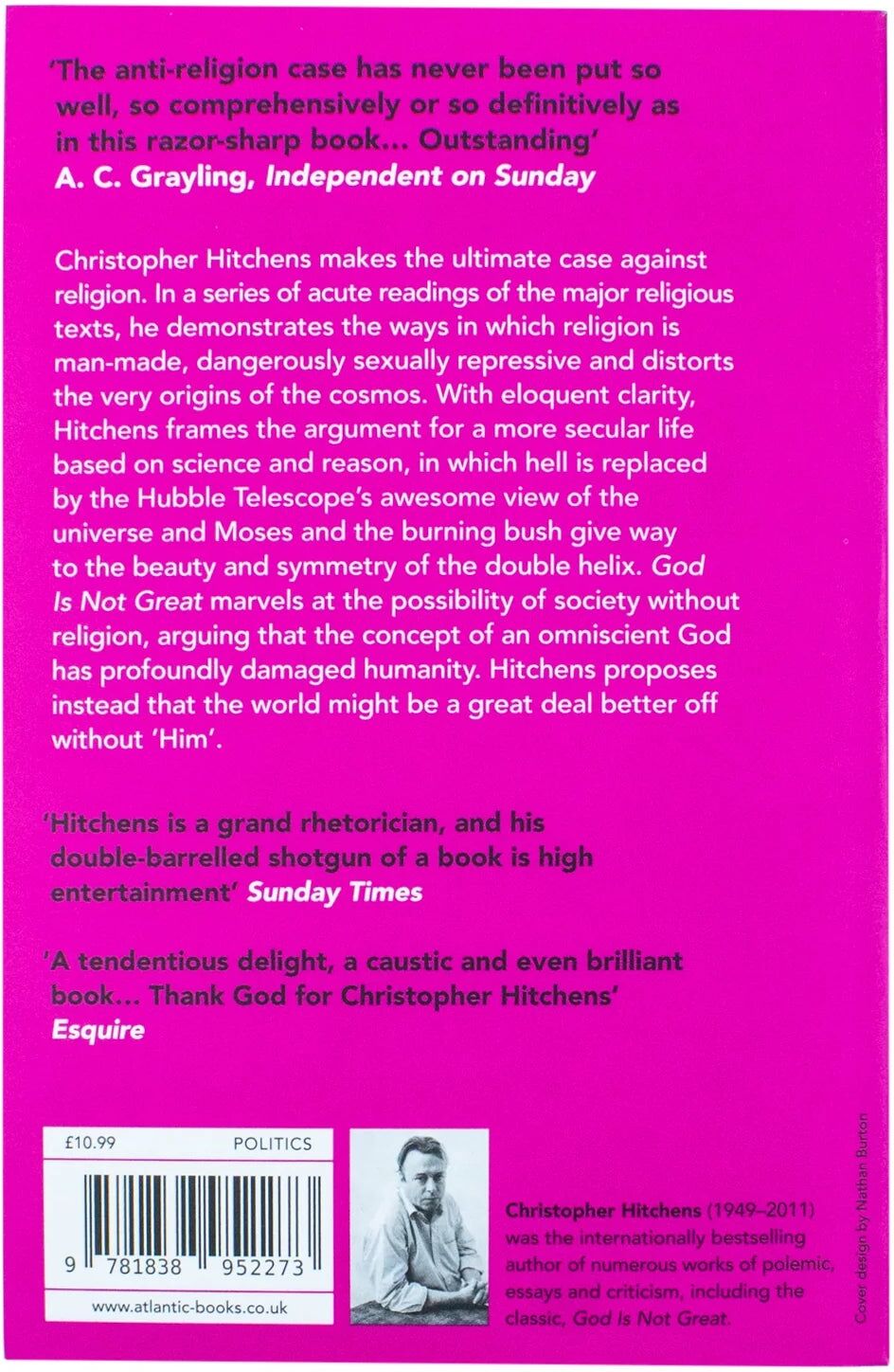
Atlantic Books God Is Not Great: The Case Against Religion by Christopher Hitchens - Paperback - Non-Fiction Religion & Philosophy - NewGod Is Not Great: The Case Against Religion is a fearless and formidably argued polemic by Christopher Hitchens that questions the role of organised religion in human history. Blending sharp wit with rigorous scholarship, Hitchens dissects sacred texts and religious institutions, arguing that faith has too often fuelled division, repression and violence. This landmark work of intellectual non-fiction remains a significant contribution to the discussion of religion and reason, essential reading for those interested in the topic. About the book, Christopher Hitchens builds a comprehensive case against organised religion, drawing on history, philosophy, science and literature. He examines the major world faiths, arguing that religious doctrine is man-made rather than divinely inspired, and that many of its claims are contentious.3,99 £*Shipping: 2,99 £Secure redirect to the provider
-
The End of Faith: Religion, Terror, and the Future of Reason by Sam HarrisDescription. This important and timely book delivers a startling analysis of the clash of faith and reason in today's world. Sam Harris offers a vivid historical tour of mankind's willingness to suspend reason in favour of religious beliefs, even when those beliefs are used to justify harmful behaviour and sometimes heinous crimes. He asserts that in the shadow of weapons of mass destruction, we can no longer tolerate views that pit one true god against another. Most controversially, he argues that we cannot afford moderate lip service to religion -- an accommodation that only blinds us to the real perils of fundamentalism. While warning against the encroachment of organised religion into world politics, Harris also draws on new evidence from neuroscience and insights from philosophy to explore spirituality as a biological, brain-based need. He calls on us to invoke that need in taking a secular humanistic approach to solving the problems of this world.. Title. The End of Faith: Religion, Terror, and the Future of Reason by Sam Harris. Delivery. Content. Reviews6,99 £*Shipping: 2,99 £Secure redirect to the provider
-
God Is Not Great: How Religion Poisons Everything by Christopher Hitchens - Non Fiction - PaperbackTitle:. God Is Not Great: How Religion Poisons Everything Condition: BRAND NEW. Format: Paperback. ISBN: 9781843545743 Overview:. God Is Not Great: How Religion Poisons Everything is Christopher Hitchens’s blistering, meticulously argued case against faith. Written with audacious clarity, it surveys a vast terrain—from ancient sacred texts to modern religious institutions—and exposes how religious belief has shaped cultures, politics, and personal morality in ways that can be harmful, suppressive, or illusory. Hitchens contends that religion is not a mere private matter, but a force with public consequences: it has often distorted science and education, justified violence and discrimination, and obstructed humane, evidence-based inquiry. Yet this is not a dry catalog of doom; it is a lucid invitation to think critically, to test ideas against reason and evidence, and to imagine a world where ethics and compassion can flourish without recourse to supernatural authority. The writing is as accessible as it is provocative, pairing crisp logic with sharp wit, making complex arguments approachable for curious readers, students, and general non-fiction lovers alike. This paperback edition brings a controversial, timely dialogue into reach for a broad audience: a fearless primer for anyone exploring the clash between faith and reason, belief and doubt, and how we choose to live together in a secular age. What Makes This Book Stand Out:. Few books fuse polemic with scholarship as effectively as God Is Not Great. Hitchens brings a panoramic read—textual analysis of sacred writings, historical case studies, and cultural critique—into one compact, argument-driven volume. He uses accessible, often quotable prose to illuminate how religious narratives shape laws, education, and public policy while posing hard questions about morality outside doctrinal dictates. The book’s strength lies in its relentless, cross-disciplinary reach: philosophy, history, anthropology, and science intersect to question authority without silencing dissent. Hitchens’s voice—witty, unswerving, and intellectually rigorous—transforms a controversial stance into a compelling intellectual adventure. For readers seeking a sturdy, well-supported challenge to religious privilege, this work remains a benchmark in secular thought, inviting readers to examine how belief systems influence everyday life and to consider the benefits of a reasoning-driven worldview. Who This Book Is Perfect For:. Ideal for adults and young adults with an appetite for rigorous ideas and lively debate. It suits students studying religion, philosophy, or political history, book clubs focused on non-fiction inquiry, and gift buyers seeking a provocative, conversation-starting title for skeptics and curious readers alike. If you enjoy clear, evidence-based arguments about big questions—how belief intersects with science, governance, and ethics—this book will resonate. It also serves as a bold, conversation-sparking...10,99 £*Shipping: 2,99 £Secure redirect to the provider
-
Which religion is most similar to my belief?
It is difficult to determine which religion is most similar to your belief without knowing more specifics about your beliefs. However, some religions that share similarities with many belief systems include Unitarian Universalism, which emphasizes individual spiritual growth and the search for truth, and Buddhism, which focuses on mindfulness, compassion, and the interconnectedness of all beings. It may be helpful to explore various religions and spiritual practices to find one that resonates most with your personal beliefs and values. **
-
In which religion do people pray similar to Muslims?
People who pray in a similar manner to Muslims can be found in the religion of Islam. Muslims pray five times a day facing the Kaaba in Mecca, reciting specific prayers and verses from the Quran. The act of bowing and prostrating during prayer is also a common practice among Muslims. Other religions, such as some sects of Sufism in Islam, may also have similar prayer practices. **
-
Is substitute religion the same as religion replacement?
No, substitute religion and religion replacement are not the same. Substitute religion refers to alternative belief systems or practices that individuals adopt in addition to their traditional religion, while religion replacement involves completely abandoning one's original religion in favor of a new belief system. Substitute religion allows individuals to incorporate elements of different faiths into their lives, whereas religion replacement involves a complete shift in religious identity. **
-
What distinguishes a religion from a substitute religion?
A religion is typically characterized by a belief in a higher power or powers, a set of sacred texts or teachings, and a system of rituals and practices. It often provides a framework for understanding the meaning and purpose of life, as well as guidelines for moral behavior. A substitute religion, on the other hand, may lack some or all of these elements, but still fulfills a similar role in providing meaning, community, and a sense of purpose for its followers. Substitute religions may include belief systems, ideologies, or even activities such as sports or political movements that fulfill some of the same functions as traditional religions. **
Similar search terms for Religion
-
The Righteous Mind: Why Good People are Divided by Politics and Religion by Jonathan HaidtDescription. 'A landmark contribution to humanity's understanding of itself' The New York Times. Why can it sometimes feel as though half the population is living in a different moral universe? Why do ideas such as 'fairness' and 'freedom' mean such different things to different people? Why is it so hard to see things from another viewpoint? Why do we come to blows over politics and religion?. Jonathan Haidt reveals that we often find it hard to get along because our minds are hardwired to be moralistic, judgemental and self-righteous. He explores how morality evolved to enable us to form communities, and how moral values are not just about justice and equality - for some people authority, sanctity or loyalty matter more. Morality binds and blinds, but, using his own research, Haidt proves it is possible to liberate ourselves from the disputes that divide good people.. Title. The Righteous Mind: Why Good People are Divided by Politics and Religion by Jonathan Haidt. Delivery. Content. Reviews99,99 £*Shipping: 0,00 £Secure redirect to the provider
-
Neositrin Complementary Shampoo 100 mlHealth and Beauty Shampoos Neositrin Complementary Shampoo 100 ml Neositrín Shampoo, with quassia amara extract, easily removes lice and nits, leaving hair clean and shiny. It has a pleasant scent and is hypoallergenic.11,30 £*Shipping: 3,99 £Secure redirect to the provider
-
Acroma Adjustable Single Curtain Rod and Coordinating Finial SetElevate your space with minimalist elegance: Adjustable Single-Rod Curtain Rod. Tired of curtain rods that clash with your windows? Fed up with rods that restrict your every move? Our adjustable single-rod curtain rod will transform your experience.46,99 $*Shipping: 0,00 $Secure redirect to the provider
-
Acroma Adjustable Single Curtain Rod and Coordinating Finial SetElevate your space with minimalist elegance: Adjustable Single-Rod Curtain Rod. Tired of curtain rods that clash with your windows? Fed up with rods that restrict your every move? Our adjustable single-rod curtain rod will transform your experience.49,99 $*Shipping: 0,00 $Secure redirect to the provider
-
Is Buddhism a religion or a critique of religion?
Buddhism can be seen as both a religion and a critique of religion. It is considered a religion because it involves beliefs, practices, and rituals centered around the teachings of Siddhartha Gautama, also known as the Buddha. However, Buddhism also critiques traditional religious concepts such as the existence of a creator god and the idea of a permanent self. It emphasizes personal spiritual development, mindfulness, and the pursuit of enlightenment through self-awareness and compassion, which can be seen as a critique of certain aspects of organized religion. **
-
What is the difference between religion and substitute religion?
Religion refers to a formal system of beliefs, practices, and rituals centered around a higher power or spiritual force, often involving organized institutions and communities. Substitute religion, on the other hand, refers to non-traditional belief systems or practices that serve as a replacement for traditional religion. Substitute religions may include alternative spiritual practices, self-help movements, or other forms of belief and community that fulfill similar roles to traditional religion for their followers. While religion is often associated with established traditions and institutions, substitute religion may be more individualistic and diverse in its manifestations. **
-
Is religion unnecessary?
Religion is a deeply personal and subjective matter, and its necessity varies from person to person. For some individuals, religion provides a sense of purpose, community, and moral guidance that enriches their lives. Others may find fulfillment and meaning through secular beliefs and practices. Ultimately, whether religion is necessary depends on an individual's values, beliefs, and experiences. **
-
Is religion reprehensible?
The question of whether religion is reprehensible is subjective and depends on individual beliefs and experiences. Some people may find religion to be a source of comfort, community, and moral guidance, while others may view it as a source of division, intolerance, and harm. It is important to recognize that religion, like any belief system, can be used for both positive and negative purposes, and it is crucial to approach the topic with an open mind and respect for differing perspectives. **
* All prices are inclusive of VAT and, if applicable, plus shipping costs. The offer information is based on the details provided by the respective shop and is updated through automated processes. Real-time updates do not occur, so deviations can occur in individual cases. ** Note: Parts of this content were created by AI.